By Mike Collins · 14 September 2026
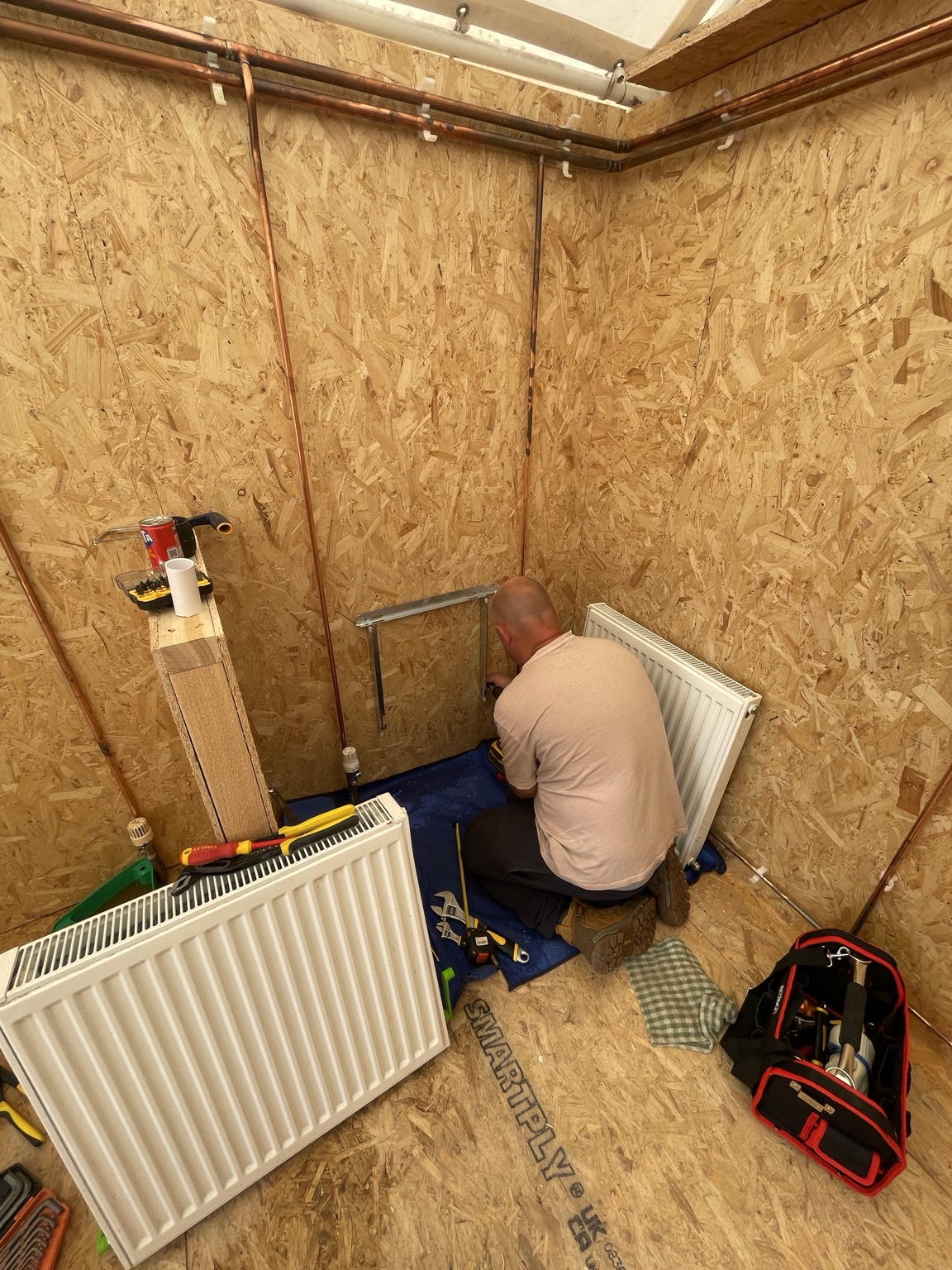
Stand in the plumbing aisle at any merchant and you'll see two shelves competing for your money: brass compression fittings and plastic push-fit. Both are safe when used properly, and both will hold water for decades. So which one should you reach for? I use both, and my honest answer is that it depends on the job — but there are a few places where one is clearly the better choice. Here's how each one actually seals, and where the mistakes happen.
A compression fitting is a brass nut, a brass body and an olive — a soft metal ring that sits between them. Slide the nut and the olive onto the pipe, push the pipe into the body, and tighten the nut. As it turns, the nut squeezes the olive so it grips the pipe and squashes into a metal-to-metal seal. No heat, no flux, no torch. It's the joint you'll find under most sinks in Britain, and it's how nearly every tap connector and isolation valve attaches.
The skill is in the tightening. Do the nut up hand-tight, then give it roughly a quarter to half a turn with a spanner — then stop. The classic DIY error is fear: it weeps a drop, so you lean on the spanner and go round again. An overtightened olive crushes and never seals properly again, and the nut can even split. If a compression joint weeps after a sensible tighten, undo it and remake it with a new olive. A new olive costs pennies; a second weeping joint costs a ceiling.
Push-fit does what the name says. Inside the fitting there's a grab ring of stainless teeth and an O-ring. Push the pipe in past the teeth and they grip; the O-ring does the sealing. To remove it, you press the release collar or use a small release tool. No spanner, no heat, no paste.
Two rules matter. First, the pipe has to go all the way home. Push-fit fittings have a depth stop, and a half-seated joint looks finished and leaks a week later — so mark the insertion depth on the pipe and check the mark disappears into the fitting. Second, if you're using plastic pipe, use the manufacturer's pipe inserts. The insert stops the pipe wall collapsing inward under the grip, which is what ruins the seal. It's a ten-penny part, and leaving it out undoes the whole job.
Compression is my choice when the joint might need undoing again — service valves, tap connectors, anything feeding an appliance — and on visible copper where you want the work to look like proper plumbing. Brass shrugs off heat, so it sits happily on pipes that run hot. The trade-offs: it's slower, it costs a bit more per joint, and it needs a spanner and a little judgement.
Push-fit wins on speed and awkward access — behind a bath panel, up in a cupboard, anywhere a spanner won't swing. It joins plastic to copper without an adaptor, and it comes apart cleanly if you change your mind. The trade-offs: check the rating on the box, because the ranges differ. Heating-rated push-fit is made for central heating temperatures; standard ranges are meant for hot and cold water only and are limited to around 65°C. And whatever the brand says, push-fit is never for gas.
One more honest note: fittings tucked behind tiles or boxed in — whichever type they are — should be joints you could still get to if you ever had to. Hidden is fine. Unreachable is a bet.
On compression: overtightening, reusing an old olive, and cutting the pipe out of square so the olive never seats flat. On push-fit: not pushing fully home, forgetting the insert in plastic pipe, and leaving a ragged hacksaw cut that chews the O-ring seat — cut square and deburr. Neither fitting is difficult. Square cut, deburr, right depth, tighten sensibly. That's most of it.
If the joint is visible, might come apart again, or carries serious heat — compression. If it's hidden, awkward, or you want it done in five minutes — push-fit. Most jobs have room for both, and mixing the two on one system is completely normal.
On the 3-Day Complete Plumbing Course (£550 flat, small groups at our Deeside centre) you make compression, push-fit and soldered joints on the rigs until they hold water — and you feel the difference between right and slightly-out, which is the part you can't learn from a video. Skills Club on Thursday evenings (£30) is the cheap way to keep the hand in between jobs.
Not sure which fittings are on your pipes, or whether that joint you made is sound? Message me on WhatsApp on 07414 249796 — send a photo and I'll tell you what you're looking at.