By Mike Collins · 12 September 2026
 Mike Collins · Instructor, The Plumbing School · 12 September 2026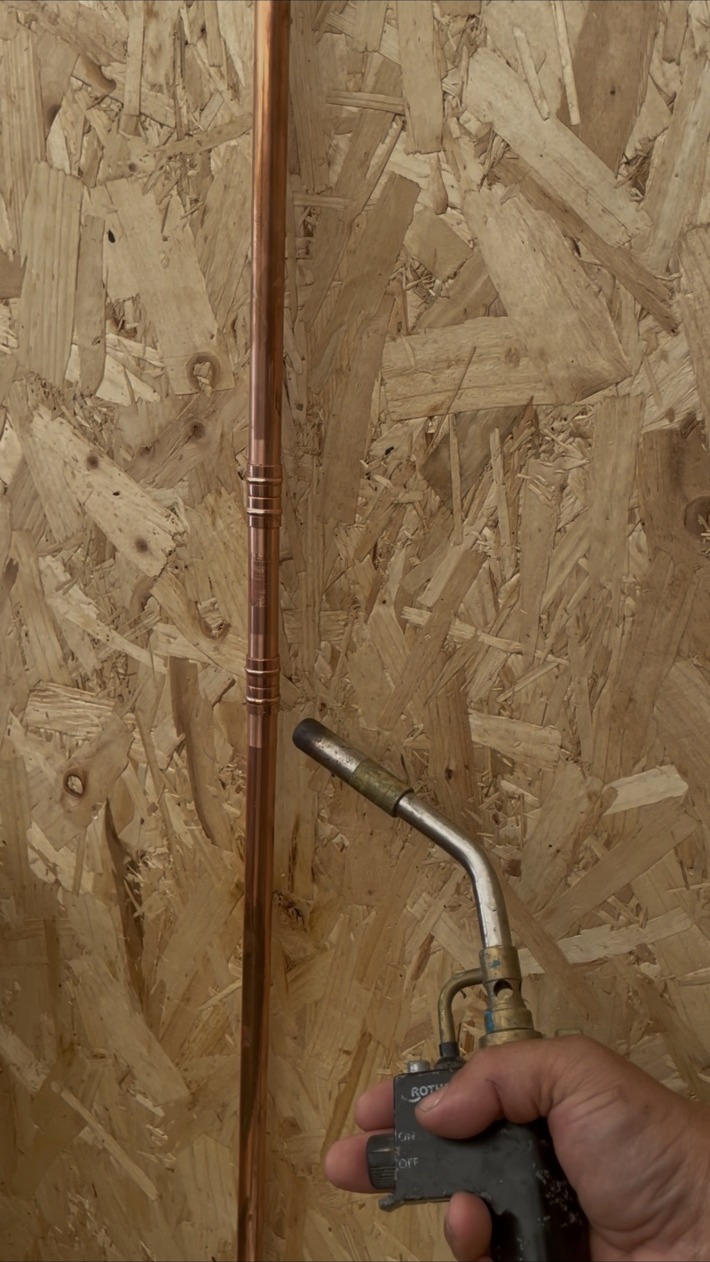
Join two copper pipes and you have three honest choices: compression, push-fit or soldered. Compression and push-fit are fine — but a soldered joint is the one that looks like proper plumbing, sits neatly inside a wall and never works loose. And there are two kinds you’ll meet: Yorkshire and end-feed. People ask which is “better”. They do the same job; they just ask different things of you. Here’s the difference, and where I’d start.
Solder doesn’t glue copper together. It melts, then gets drawn into the hair-thin gap between pipe and fitting by capillary action — the same way water climbs a paper towel. For that to happen, three things must be true. The copper has to be clean — bright, scratchy-clean with wire wool, right up to the stop, because any oxide left on the metal stops the solder bonding. The joint has to be fluxed — a paste that strips the last of the oxide and stops the metal tarnishing while you heat it. And the whole joint — pipe and fitting together — has to reach soldering temperature at the same time.
Miss any of the three and the solder sits on the surface instead of creeping inside. That’s a cold joint. It looks finished, and it leaks a fortnight later when nobody’s watching. Most failed solder joints are cleaning failures, not heating failures.
A Yorkshire fitting has a ring of solder pre-loaded in a groove inside the socket. The flux, though, is not done for you — despite what plenty of people assume. You still clean the pipe bright, flux the end of the tube (and a smear inside the fitting), push the pipe to the stop, mark the depth so you know it’s home, wipe off any excess flux, and heat. Yorkshire’s own fitting instructions say exactly that: flux the tube, insert to the stop, wipe the surplus, then heat. When the joint reaches temperature the ring melts, and you’ll see a neat, complete ring of solder appear all the way round the mouth of the fitting. That ring is your inspection window — no complete ring, no joint.
Because the dose is fixed, Yorkshire is forgiving: you can’t under-fill one, and there’s no wire to feed while you hold a flame. The trade-offs: the fittings cost more, and if you overheat one the ring can run straight out of the mouth and leave a void inside. Gentle heat, watch the mouth, take the flame off the moment the ring is whole.
An end-feed fitting is just a shaped copper socket — no ring, no flux pocket. Everything else is the same, but you feed the solder: bring the joint to temperature, touch end-feed solder wire to the mouth, and let the hot copper pull it in, working it round the pipe until the joint is full. You know you’re there when the solder stops vanishing into the fitting and starts to sit proud at the mouth.
This is the joint most heating engineers use every day. It’s cheaper per fitting, uses less solder, and the joint inside is neater. It isn’t harder because of strength — a properly made end-feed joint is as strong as the pipe itself. It’s harder because nothing is done for you: you judge the temperature by eye and feed at exactly the right moment. Feed too early and the solder bounces off cold copper; too late and you’ve cooked the flux and it won’t travel.
If you’ve never soldered, start with Yorkshire. The built-in ring gives you a margin for error, and the solder ring tells you honestly whether it worked. Move to end-feed once you can read the heat — it’s quick, cheap and genuinely satisfying once it clicks.
Three things ruin either type. Water in the pipe — even a trickle carries heat away and steam pushes solder back out, so isolate and drain properly; if a pipe weeps, push a small piece of bread in to plug it while you make the joint, and let the supply wash it away afterwards — an old merchant’s trick that still earns its keep. Moving the joint while it cools — hold it dead still until the solder goes dull. And heating the wrong part — the gap is inside the fitting, so heat the socket and let the pipe take heat from it, not the other way round.
You’re waving a flame near timber, so use a heat shield pad, keep the flame moving, and have a look behind and below before you walk away — joists and accumulated dust hold heat longer than you’d think. If a fitting is buried in a tight corner against timber, or isolation is doubtful, that’s a stop-and-think moment, and a well-made compression joint does the same job with no flame at all.
Reading gets you the theory, but the temperature judgement only comes through your hands, on real pipe. Both joint types get proper bench time on the 3-Day Complete Plumbing Course (£550, small groups at our Deeside centre) — you’ll clean, flux and solder until your joints hold water — and Skills Club on Thursday evenings (£30) is the cheap way to keep the hand in between jobs.
Not sure what fittings are on your pipes, or whether that joint you made is sound? Message me on WhatsApp on 07414 249796 — send a photo and I’ll tell you what you’re looking at.